A Belizean Folklore: Tata Duende
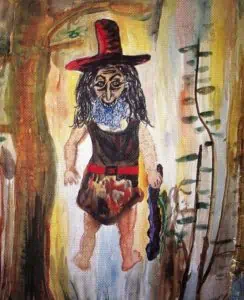
The Yucatec Maya word “Tata” translates to old man/ grandfather and the Spanish word “Duende” translates to goblin. Tata Duende is a folklore of Maya and Mestizo origin. Tata Duende is characterized as a short man about three feet with an ugly face. He is said to have no thumbs and his feet are pointed backwards making it hard to track his path. He is said to lure children in the forest never to be seen again. It is advised that if you come in contact with El Duende, you should hide your thumbs behind your palms, so he doesn’t take them. You can know if the Duende has been around because he would leave a horse’s mane in a braid! The braid is impossible to loosen so it would just have to be cut off. To keep him from bothering your horses, leave a guitar and a a bottle of rum next to a mirror – it is said that he will play the guitar and get drunk then look in the mirror and permanently scare himself away.
Allow me to share a short story about Tata Duende that I wrote special for Irvine Hall’s 2023 Culturama Festival Storytelling night. The protagonist is a Chiclero. Chicleros are men who climb and collect the sap from the chicle trees. This sap is what is used to make chewing gum.
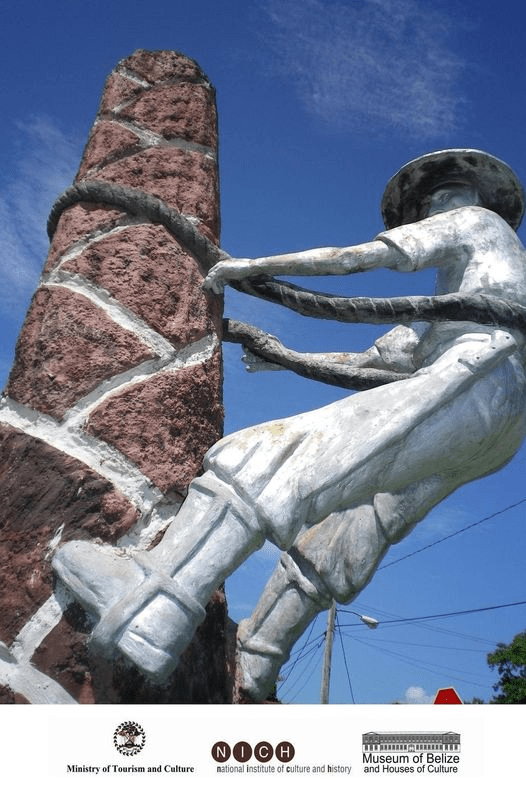
El Chiclero
Juanito takes the saddle off his horse and places it on the lower shed shelf next to his chiclero boots. He sharpens his machete and iron spurs for tomorrow’s workday before putting them in their respective pockets on the saddle. He grabs a kerosene lamp from the shed’s top shelf. He closes the shed door, heading to the kitchen. The kitchen, which is separate from the rest of the house, has a thatched roof. He finds his mother, Dona Chen, grinding corn to make tortillas for supper.
“Juanito, I heard little rocks being pelted on my bedroom window when it got dark. I looked outside and saw the shadow of a sombrero.”
He fills a pot with water from a bucket and places it on the fogón.
“Mama, don’t be ridiculous. You know Tata Duende isn’t real. That was just Don Marin’s children playing a joke on you.”
“I know what I saw, Juanito. Be careful these next few days. Take the long way home, don’t walk through the corn field after work. That’s where Dona Chen said her son’s wife’s cousin’s uncle’s daughter saw Tata Duende last month.”
Juanito rolls his eyes and pours the hot water from the pot on the fogón into a large bath pan. He adds cool water from the bucket until the water is warm enough for his evening bath, and then he carries the bath pan to the bathhouse for his evening bath. After his bath and supper, Juanito falls fast asleep.
The next night, after a long day of climbing zapote trees and harvesting chicle, Juanito is too exhausted to heed his mother’s warning. He takes the shortcut through the cornfield. His horse suddenly halts. The horse leans back with its head raised and starts making loud neighing sounds as though it is scared. Juanito hops off and tries to calm her by rubbing her smoothly. He then notices something out of the ordinary in the distance. He sees the silhouette of a small figure, about three feet tall, with a large sombrero, a long beard, and backwards feet. He looks away, rubs his eyes, and glances back toward the figure just to see that it has disappeared. He mumbles to himself, “Tata Duende isn’t real. I’m just tired.”
He gets back on his horse and makes his way home. He heads to the kitchen after preparing his tools for tomorrow’s workday and closes the shed door. He meets his mother, kneeling on the kitchen floor, picking up all her pots and pans that normally hang on the kitchen walls.
“Juanito, I tell you the Duende is near. You never want to believe me.”
Juanito is silent for the rest of the night. He doesn’t tell his mother what he saw in the cornfield. He convinces himself that everything is just a weird coincidence, that he is imagining things in the cornfield cause his mother got in his head and he is tired. He thinks that maybe a strong gust of wind blew all the pots off the walls.
Juanito wakes up during the night and lights his kerosene lamp to go to the bathroom. On his way from the house, he notices that the shed door is wide open. He is sure that he locked the door. He walks over to the shed to find his horse with a braided mane. He sets the kerosene lamp on the floor and attempts to loosen the horse’s braid. His heart starts to beat faster as he realizes he can’t loosen the braid. Juanito’s body becomes stiff as he hears faint whistling growing nearer and nearer. He turns around slowly, his heart pounding, legs shaking. He sees a tiny figure illuminated by the moonlight. Juanito sees a short, old man dressed in rags, with feet pointing backwards and no thumbs. He has a large sombrero on his long, white hair. The kerosene lamp reveals his ugly face and a sly grin. Juanito realizes that Tata Duende is standing in front of him. He quickly hides his thumbs behind his palms and screams, “Mama!”
Tecuani and the Duende
In Maya culture, Tata Duende can also be viewed as a forest spirit that protects the forest and animals. You can see this in Belize’s first animated film “Tecuani and the Duende” linked here.


 Sylvia Wynter's Dream
Leave a reply to javeirhenry Cancel reply