
By Kandice Thompson
I first got into AI Art after I saw headlines of AI (artificial intelligence) generated concept art winning a competition which sparked debates online. Netizens were concerned that AI Art may phase out the need for traditional artists and whether or not it’s fair for AI Art to compete against humans. After a spirited conversation with friends in web development and art studies we concluded that AI concept art has its place – it’s a convenient tool that can be used to produce reference images or communicate with clients for commission-based artists. A computer cannot consistently produce the kind of evocative imagery that the human brain and happy accidents can create, and they mostly rely on prompts and artwork uploaded from humans anyway. Though they should have their own categories in competitions.
Shortly after, I had to com up with a topic for a Creative Non-Fiction and Digital media course. I thought Afrofuturism might be a nice umbrella topic for the class to research, that didn’t pan out but I kept with it for my own work. Immediately, I thought this was a great opportunity to try out AI Art for myself, not recognizing the subconscious correlation of Afrofuturism and technology. I was in the early stages of my research, still brainstorming and excited about where this project could go.
During a class workshop, I quickly googled AI generator and the first free one that popped up was hotspot.ai. I didn’t overthink it, my first prompt was something like Jamaican Afrofuturism, to combine my research focus with the class topic of Jamaican Voices: Real And/or Imagined.
This image was my very first result and I was geeked,

I thought it was pretty cool and almost spot on for a free generator and it could be a good work around for copyright infringement if I had my own images to upload on my blog posts and set as featured images. I could literally conjure up the most fitting image for whatever posts I made. This was unfortunately a chance hit, as my other prompts didn’t turn out nearly as well. They were a bit deformed and poorly generated. I might have overloaded the prompts, I’m still not exactly sure what syntax works best…continuous prose or keywords, it could be website specific. I learned to refine my prompts for this specific site before I ventured out to see what other freeness did a gwaan.
I tried NightCafe Studio and again they got me with a bait and switch. My first try below was stunning but the rest were awful.

and the others that followed were low quality and visually incoherent, not like thought-provoking abstract but Frankenstein-ish. Unfortunately, I didn’t save the ugly (to me) ones to show you exactly what I mean. Nightcafe runs on credits, so you only get a few tries, I haven’t maxed out mine yet because I did not like the last few attempts. I wasted a credit to do a test run for demonstration purposes. The image below was generated from the prompt “African cyborg” with the Modern Comic style on NightCafe.

It ugly don’t it?
So I did my googles and I found Dream by WOMBO and finally, match made in heaven. Like Nightcafe it offers styles/presets to go with the prompts and give a bit more direction (to the human and software) which is great. I didn’t see that NightCafe had a bunch more presets until later, but it didn’t matter at that point.
Note that the free generators usually produce smaller, possibly low-quality images. I haven’t bought credits to see what it’s like on the other side, but I can only assume you’d be getting more if you’re paying.
The Dream.ai images were consistently hitting for me, there were a few misses here and there, but I quickly figured out certain styles are best with certain prompts. For example, if I used the Ghibli styled (inspired by my favourite animation studio) with more humanoid prompts like “man with a drum” or “stranger things Jamaican kids” I’d get a jumbled, glitchy mess, those kinds of prompts were better suited for the Cartoonist style. If I did something more landscape focused like African utopia or African Castle in the Sky (my favourite studio Ghibli film) with the Ghibli style, I’d get great results. It was fun pushing the limits of each style to see what could work, honestly a lot of their “fails” still look good, actually abstract. I made a Flickr album of my favourite images, all within the Afrofuturist theme,
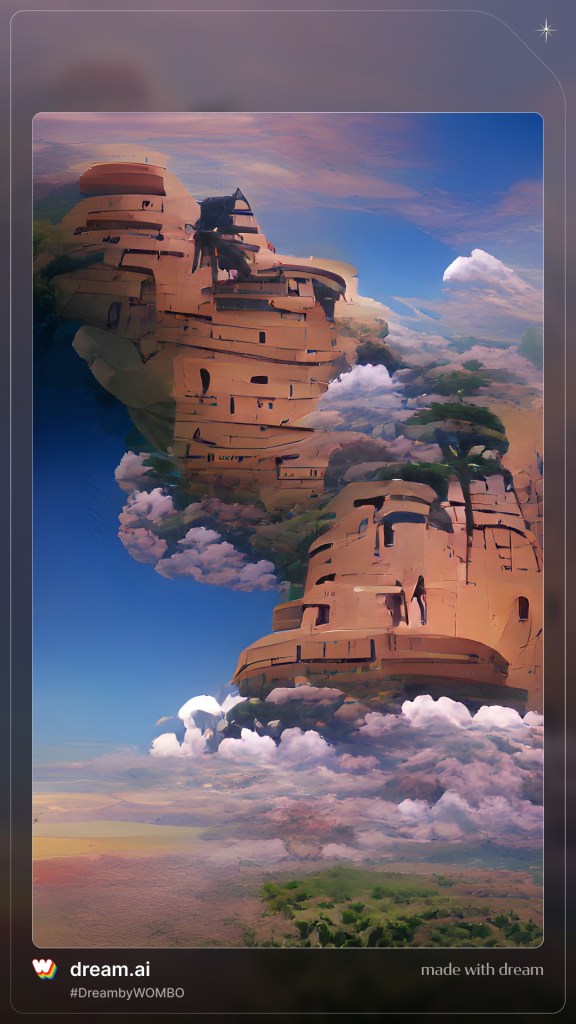
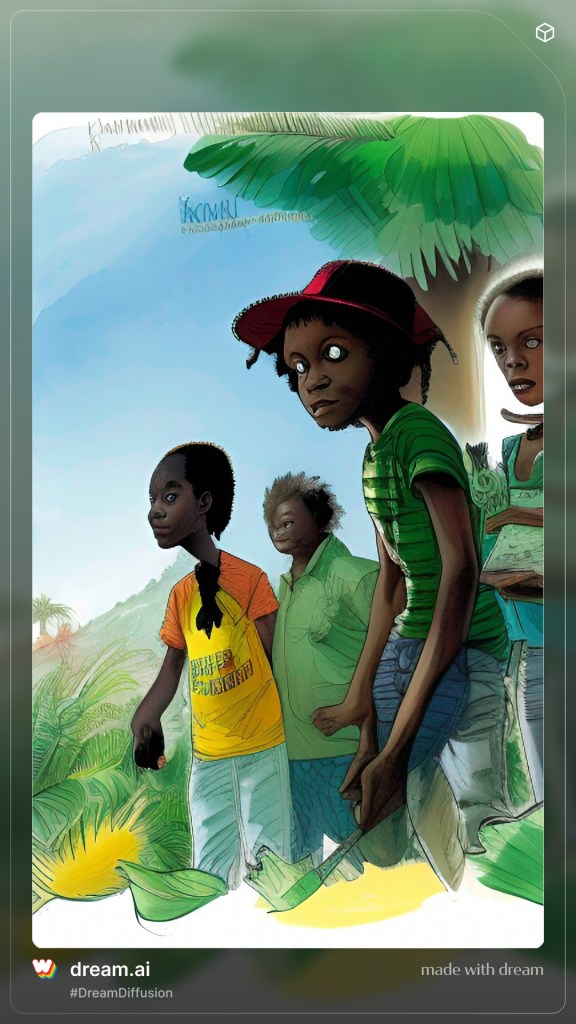
With Dream.ai I also started used reference image, where you upload your own reference image and adjust the level of influence your image has on the final artwork produced. This was cool as I had begun to rapidly generate images, having fun but not really taking note of what style and prompt combination produced my favourite images. So, I used a generated image for reference, it was okay, but then I tried a still from Black panther: Wakanda Forever and it worked great with many styles. It is limited in that you have to crop the image to fit their small frame.
The glaring issue with this came up when I used my own photo as a reference, and it brings up the issue of racial discrimination. Yes, even with an AI generator that has access to the internet archives and black people – cue a deep spiritual negro sigh. I wish I had recorded it, I think the prompt was something along the lines of “African woman” (another point of contention), nothing too crazy and it turned me every race and gender except my own! I even turned up the influence to strong, I saw myself as a white woman, Native American woman, Asian man, I stopped pressing the Generate Again button, it was ridiculous. The fact that I must specify Black or African every time is also a problem.
I can understand the need to be specific, that’s the point but why is the default for any humanoid generation non-black? The default is pale skin and Eurocentric features (always blue or light eyes even with a darker skin tone), even when they have an unambiguously Black woman in braids, as a reference. It is concerning but not new or surprising as facial recognition technology has been iffy with skin colours and features and we know this is in part because the developers are non-black and tailor their software to be exclusive. I’d hate to say we need more black people in another niche field just to fix this one issue, as it is very much a first world problem. But, long term, big picture, it’s so important that we have our own people with our considerations in mind in leadership positions on these development teams, so we’re not coded out of existence or haphazardly thrown in out of obligation or social pressure.
Given that my focus was Afrofuturism I knew I had to be super deliberate, but it was annoying to have to continue to be even when I was just playing around. This really shouldn’t be a thing, why should we have to remind everyone that we are people that exist? It is exhausting but it reminds me why an Afrofuturist school of thought is so important and necessary and should be more mainstream outside of entertainment. I hope this project, can function as a database or launch pad for people to explore and learn for themselves how valuable and essential it is to imagine for ourselves and take the future into our own hands.
On a positive note, enjoy a sort of nice image of me. My little rant inspired me to have another go at the reference image bit. It took three cycles but with the prompt “glittering” and image influence set to strong, here’s an AI generated me:


 Sylvia Wynter's Dream
Leave a comment