
Introducing Me
I am Sosania Tomlinson, a final year student from the department of Humanities and Education, pursuing a B.A in History and a minor in Literatures in English.
I took an interest in this class not just as a part of my requirement to complete my degree, but also because of my own personal interest in the creative. I have always taken an interest in all forms of creative artistic expression such as film, photography, and fiction writing in the form of flash fiction and micro poetry. This course is now a personal challenge to me to take myself out of the fictional space and try creative non-fiction.
Digital Humanities Simplified For The Novice Like Me.
First and foremost Digital Humanities to put it simply is the bridge between computer-based technologies and the discipline of humanities. In doing so it allows for the fusion of aspects of computer science with key elements that lend blend seamlessly into the digital world such as media and communication, languages, arts, and literature. Thus creating a partnership between the two disciplines and creating a new space that facilitates innovation and collaboration amongst learners and facilitators.
Here is a link to a quick video that I found helpful in understanding Digital Humanities:
Where’s The Credibility?
Matthew K Gold’s article entitled ‘The Digital Humanities Moment’ speaks about both the potential good and bad of Digital Humanities. The article starts out by addressing the projected good that embracing Digital Humanities offers, such as its viability as it relates to encouraging new research methods, collaboration, and also the inclusion of adult learning otherwise known as pedagogy. Gold believed that it could be used to not only advance research in the field of Humanities but also positively impact teaching.
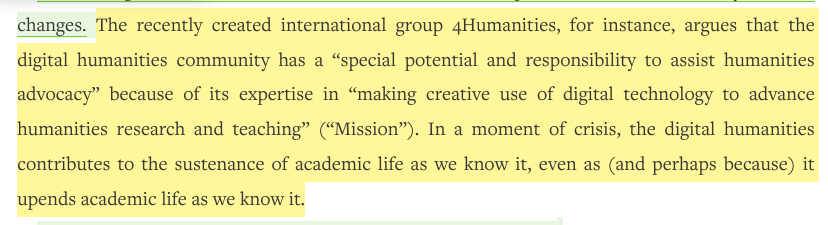
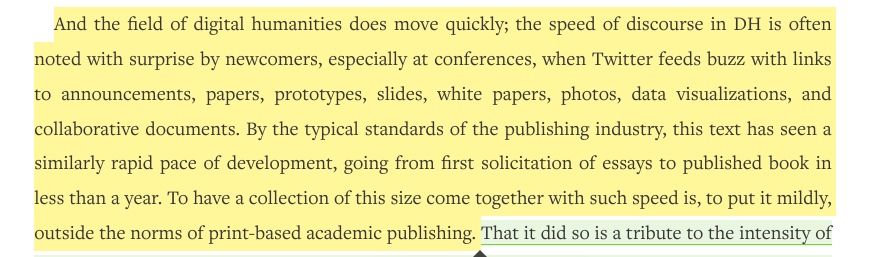
Like any good article not rooted in bias, we must also analyze the negative impacts which Gold also addresses as well. The first is conflict that has emerged in the digital space as a result of all the fresh new voices in the field. The article speaks about the fact that the traditional approach to the discipline faces the threat of being overshadowed and eventually rewritten altogether to make room for the influx of new practitioners. The speed at which growth happens in the Digital Humanities space is also a cause for some of the growing pains discussed in the article as well as due to the challenges it poses with publishing when compared to traditional academic publication.
Where Do We Fit In?

Given that Digital Humanities can be viewed as a partnership between technology and the field of Humanities, it is my belief that as a course focused in the realm of the digital we have much to gain. Digital Humanities allows for the use of a multitude of digital tools to not only encourage creativity but also encourage critical thinking. Let us not forget the huge role integration plays in courses like our own Creative Non- Fiction, which especially calls for collaboration through peer review, networking and teamwork.
Citation:
Matthew K. Gold, Introduction: The Digital Humanities Moment


 Sylvia Wynter's Dream
Leave a reply to Sarah Cancel reply