Here is a list of Nèg Mawon sites that were either strongholds, storage or ambush sites. There are many possible sites such as these, but further archaeological research is needed to confirm their status. The Nèg Mawon sites that have not already been destroyed by development, if not documented and preserved, are vulnerable to being lost for good.
Piton Flore
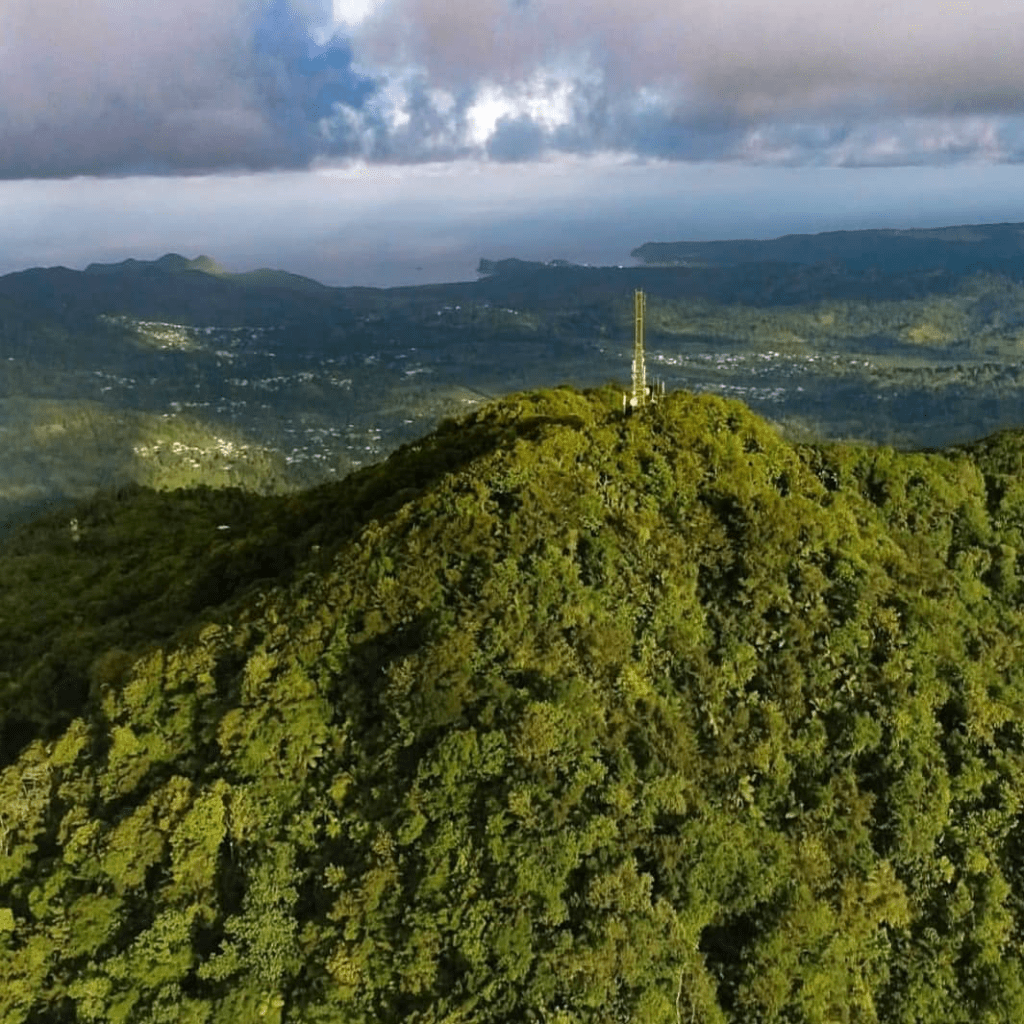
A photo of Piton Flore by Soulful Taxi Saint Lucia
This mountain was named after Flore Bois Gaillard, a coloured woman who was a prominent leader among the Nèg Mawon. There was a Nèg Mawon camp called Camp Décedé on Piton Flore. From this camp, Marin Pèdre (a Nèg Mawon leader) defeated a troop of British soldiers with the help of 60 Nèg Mawon (comprised of women, children, and some older men). He lured the British into a pit with sharp sticks. When they tried to escape, Marin Pèdre blew a trumpet, pretending to call reinforcements, which caused the soldiers to panic and flee.
La sorcière

A photo of la Sorcière chriscoxoriginals.com
This mystical mountain is named after a witch due to its reputation as being disconcerting to traverse. It was very well utilised by the Nèg Mawon, who used its large caves as depots and outposts. It was a stronghold and was said to have housed 1000 people.
Kai Solda (Soldier House)
This site, a northern projection of Anse Lavoutte, was previously a landing post for receiving ammunition and other supplies. It consisted of ten holes connected by tunnels and was used to store provisions. After being discovered by British troops, it was blocked with large boulders, making the site useless. This area is still known as Kai Solda to this day.
Mokoji (origin unknown)
A Nèg Mawon camp in Choiseul from which an ambush was staged against the advancement of British troops on 18 April 1795. It is a hole located north of the town of Choiseul and may have been damaged by British interference.
SOURCES:
Devaux, Robert J. They Called Us Brigands: The Saga of St. Lucia’s Freedom Fighters. Optimum Printers, 1997.
Harmsen, Jolien et al. A History of St Lucia. Lighthouse Road, 2012, pp. 60-88.
 Sylvia Wynter's Dream
Leave a comment