Following European colonisation, gendered pronouns have become the norm in language usage. Nonetheless, with the increasing number of individuals adopting gender-neutral pronouns, the perception of gendered language as the default is changing.
Gender-neutral terms are not a contemporary craze. They have existed for hundreds of years, dating back to the 14th century in Europe. The gender-neutral West African language syntax is only one example of the many non-gendered linguistic structures that can be found worldwide.

Abstract illustration of gender neutrality inspired by West African art
The gender-neutral pronouns that exist in Kwéyòl do more than offer a sense of inclusivity for persons who reject gendered pronouns. Kwéyòl transcends the gender binary as it blurs the lines between a distinctly defined male and female paradigm.
Find out more about gender neutrality in Kwéyòl here.
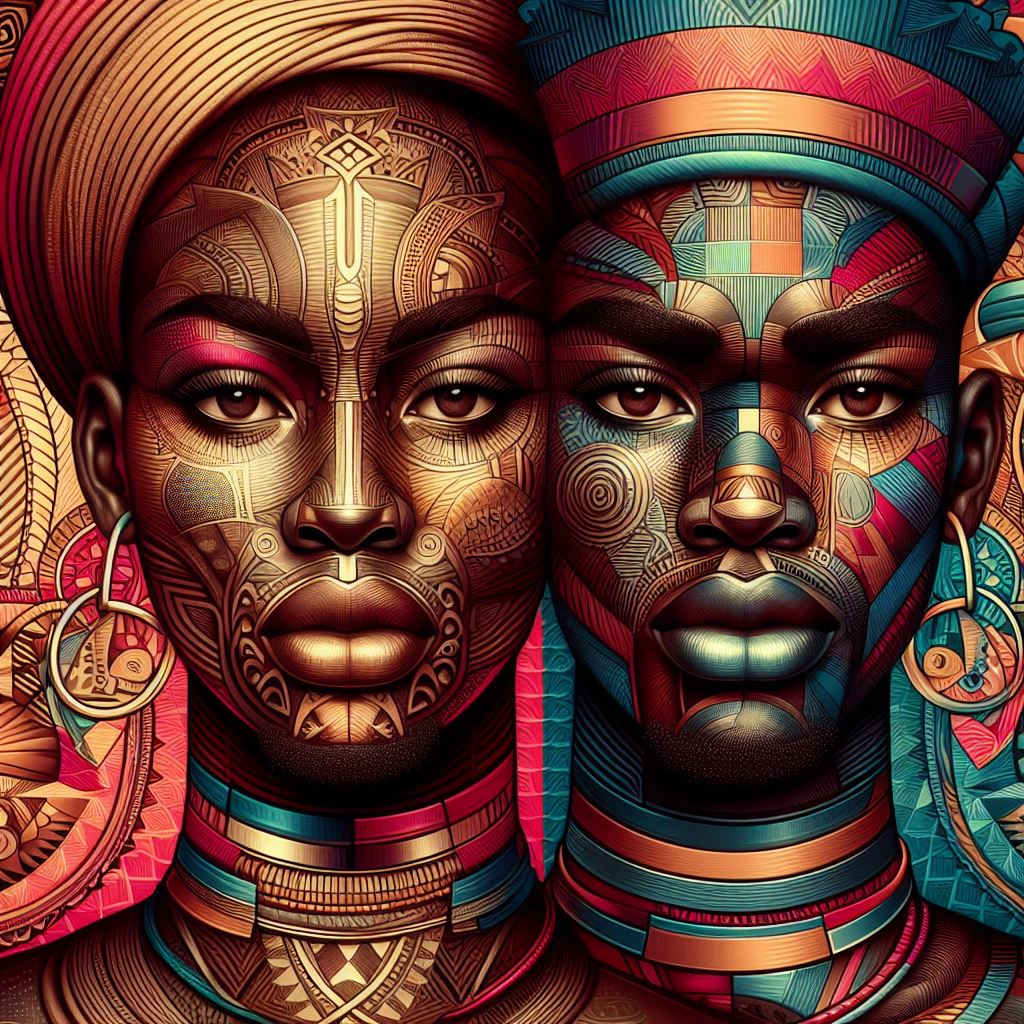
Abstract illustration of androgyny inspired by West African art
What is interesting about the language is that it includes ‘it,’ the pronoun used to refer to animals and objects. The pronoun ‘i’’ is an all-encompassing signifier corresponding to anything referred to in the third person singular.
Placing ‘he/she’ and ‘it’ into the same category is a subtle decentering of anthropocentrism. Not only does it dismantle the gender binary, but it also blurs the boundaries between humans and nonhumans. It removes any opportunity for the hierarchising of pronouns that exist in English. The connotations of superiority that arise from using ‘he/she’ in opposition to ‘it’ have no foothold in Kwéyòl.

Abstract illustration of blurring the line between human and nonhuman
Even though socially, humans and nonhumans are perceived to occupy different rungs in the social hierarchy, linguistically, they share space equally within the inclusive pronoun ‘i’.
Kwéyòl is a language hundreds of years old, and the West African languages it inherited its linguistic structure from are even older. Despite its age, Kwéyòl has been subtly expressing non-anthropocentric values before this was even a term in contemporary vernacular. It reflects a posthumanist futurity that goes largely unrecognised but is valuable nonetheless. A fact I hope will be acknowledged someday.
 Sylvia Wynter's Dream
Leave a comment