by jessiemayers
I am a storyteller deeply rooted in the bedrock of Saint Lucian culture and history. My name is Jessie, a scholar, writer and lover of epic stories. I am a Literatures in English major and a Film Studies and Creative Writing minor at the University of the West Indies in Mona, Jamaica. I am pursuing this course, Creative Non-Fiction and Digital Media, to hone my writing skills. My focus for this course will be on linguistic or cultural amnesia in a Saint Lucian context.
Digital Humanities… huh?
Before reading Kelly Baker Josephs’ essay, DH Moments, Caribbean Considerations: On Reaction, Response, and Relevance in the Digital Humanities, I had no idea what Digital Humanities was about. But after a ‘brief’ day and a half of research, I could finally wrap my head around what she was saying. I wanted to expound on Dr. Josephs’ point on the importance of Digital Humanities (DH) in activism for marginalised communities. But I’d also like to draw attention to the difficulties that Digital Humanists face when using digital platforms for activism.
So… What is the Digital Humanities?
Digital Humanities is (basically) how technology (digital tools) aids, improves and expands research methods within the traditional humanities fields and enables multidisciplinary collaboration on projects. Now that I have attempted an explanation, I shall coyly insert a video that will explain it better than I have.
Digital Humanities and Activism
If you’re still confused about what DH is, that’s okay. Even Dr. Josephs admits that defining this ever-evolving area of study is an ongoing process.
However, Dr Josephs believes that the most crucial function of DH is the accessibility of its findings and its positive impact on the public.
Dr Josephs focuses on Digital Humanities as a crucial tool for activism. The role of digital projects within the DH domain should highlight the experiences of vulnerable and underrepresented communities to encourage social change.
For example, Digital Humanities projects have made information previously kept within the confines of aloof libraries and archives more accessible to the public through online databases, such as the Former British Colonial Dependencies Slave Registers.
DH, more common than you think.
What piqued my interest was the realisation of the link between Digital Humanities and social media. Dr Josephs spotlights photographer Ruddy Roye as a Digital Humanist.
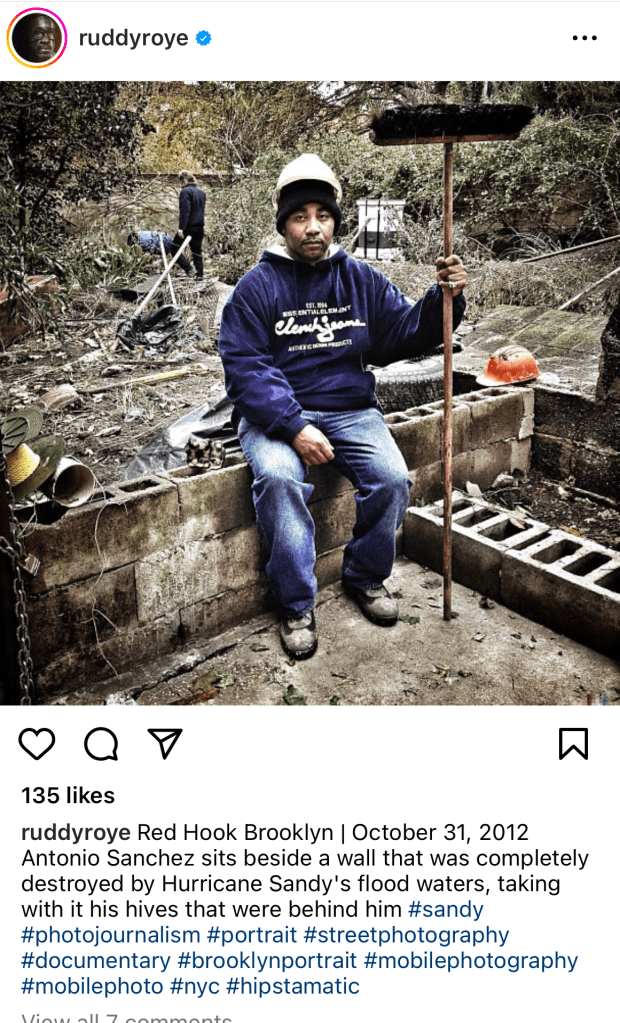
Ruddy Roye used Instagram as a platform to highlight Hurricane Sandy’s impact on New York City. His images and caption stretched the boundaries of what a social media app like Instagram, at the time, could be used for.
Finally, a breakthrough! It had finally clicked, and my excitement began. The realisation that Digital Humanities positions any digital platform as a site for learning and sharing knowledge. Digital Humanities is all about the memes, infographics, reels, and other content I interact with regularly! Essentially, we are all involved in some aspect of Digital Humanities by being on any social media app.
So, does this mean that anyone can be a digital humanist?
I think so, and I have a particular person in mind!
The Rise of the Caribbean Bad Gyal
Dr Josephs’ example of Ruddy Roye had me thinking of my favourite Instagram activist.
Saint Lucian Historian Fiona Compton owns and curates Know Your Caribbean, an Instagram page that shares content on Caribbean history and culture. Her page is filled with snapshots, articles, archival documents and other footage dedicated to retelling and venerating Caribbean history.
Her posts frequently feature the various ways Caribbean people have and continue to rebel in our flavourful and colourful ways during colonial and postcolonial times.
My favourite series: #chroniclesofthecaribbeanbadgyal
Fiona’s activism on Instagram has made Caribbean history more accessible. Caribbean people within the region and the diaspora can now view their history from a perspective outside the colonially manipulated historical textbook.
Fiona unearths Caribbean history from the hoarded and hidden places within Colonial archives that few Caribbean people can access.
Although Fiona is quite active on Instagram, sharing content has can be very tricky. To reiterate one of Dr. Josephs’ main points, information from digital projects is only as relevant if it’s accessibility to the public.
Although social media has made sharing information easier, it comes with restrictions that stunt public access, particularly for causes like Fiona’s.
The IG Algorithm: Friend or Foe?

The Instagram algorithm is governed by policies based on community guidelines that dictate what content is suitable for sharing. These guidelines are meant to ensure the platform is a space where users can share, respectfully interact, and cultivate a ‘diverse audience’.
But this is definitely not always the case.
Tricking the Algorithm
At times, Know Your Caribbean followers often go days, even weeks, without seeing any of Fiona’s posts. Until one day, a post pops up on their timeline that doesn’t contain the usual historical or cultural picture. Instead, the image is of Fiona in her black bikini.

Welcome to shadow banning, where posts that Instagram believes go against its guidelines are hidden from the public. Ironically, Instagram seems to censor educational posts in favour of “thirst traps“.
#IGQuitPlayinWithOurContent
Here’s a study that finds this to be true: Undress or Fail
“Posts that contained pictures of women in undergarment or bikini were 54% more likely to appear in the newsfeed… By contrast, posts showing pictures of food or landscape were about 60% less likely to be shown in the newsfeed.”
Quote From Undress or Fail
Building Community with DH

The importance of pages like Know Your Caribbean lies within the Community that is formed around it. For Caribbean people, this page is a pedagogical tool vital to preserving and disseminating Caribbean history and culture. Dr. Josephs speaks about the importance of accessibility and what digital humanities can ethically “…do for and with our diverse publics”.

But I also think a conversation needs to be had about how digital tools threaten the dissemination of content created by and for minority communities. Digital platforms are readily available and valuable but contain algorithms that echo historical colonial ideologies that continue to restrict minority communities.
Digital humanists should examine the negative impacts of the underlying prejudices within digital platforms’ policies and guidelines. These unfair restrictions prevent these platforms from being spaces where all stories can be shared and accessed. Because what is the point of a digital project if the intended audience never sees and interacts with its content?

 Sylvia Wynter's Dream
Leave a comment