
I am Alexis Guy – a final year Writing, Literature and Publishing major, a lover of the arts, a foodie that loves to cook, and above all, a proud Belizean Kriol gyal. Aside from this course being mandatory for the completion of my degree, I am enrolled in this course in order to hone my writing skills as well as to develop my knowledge and practice of the use of digital media. As a young adult who is still unsure of what career path to take, I hope to gain some clarity as to whether I would be interested in pursuing a career in Digital Media.
DH Moments, Caribbean Considerations: On Reaction, Response, and Relevance in the Digital Humanities
Even before the great digital migration brought on by the Covid -19 pandemic, Digital Humanities Activism was already in full swing. Now we might know that activism, in essence, is a process of working in an organized way to accomplish some sort of political or social change. But what exactly is Digital Humanities? And what is Digital Humanities Activism? Well, I would tell you if I knew. I thought maybe I was the problem and that my brain shrunk overnight, but from the few articles I’ve read so far, I have gathered that there might not be a definite answer. In “DH Moments, Caribbean Considerations: On Reaction, Response, and Relevance in the Digital Humanities” Josephs makes note that even though the question of what Digital Humanities, DH for short, has been posed for many years, it remains that “We certainly haven’t answered that question to everyone’s — or maybe even anyone’s — satisfaction” (2018). Yet, in an attempt to gain clarity myself, I looked to YouTube. Here is a video that I think explains what DH is and provides quite an interesting real-life example.
However, instead of focusing on what DH is, Josephs looks through the lenses of an activist and mentions that we should focus instead on what DH does for others. The examples of Digital Humanities Activism, DHA for short, discussed in this essay are Caribbean projects that spread across various issues and media. Josephs highlights the Live Hope Love project by Dawes which researched HIV/AIDS in Jamaican communities. Dawes’ project used a somewhat documentary format, somewhat because the videos did not need to be viewed in sequence for them to be comprehensive, to give a space for those “living with HIV/AIDS” to share their “vital voices.” Josephs states “Live Love Hope demonstrates how a digital platform can be designed to ethically respond to the needs of vulnerable and marginalized Caribbean communities while representing them from elsewhere” (2019), and further goes on to highlight that it is certainly not new in the areas of Caribbean and Black studies to try to bring change for the minority communities that scholars and academics in these areas work within.
My favourite example from the essay is that of Ruddy Roye, a Jamaican raised photographer who is based in New York. I scrolled his Instagram and found very fascinating pieces.
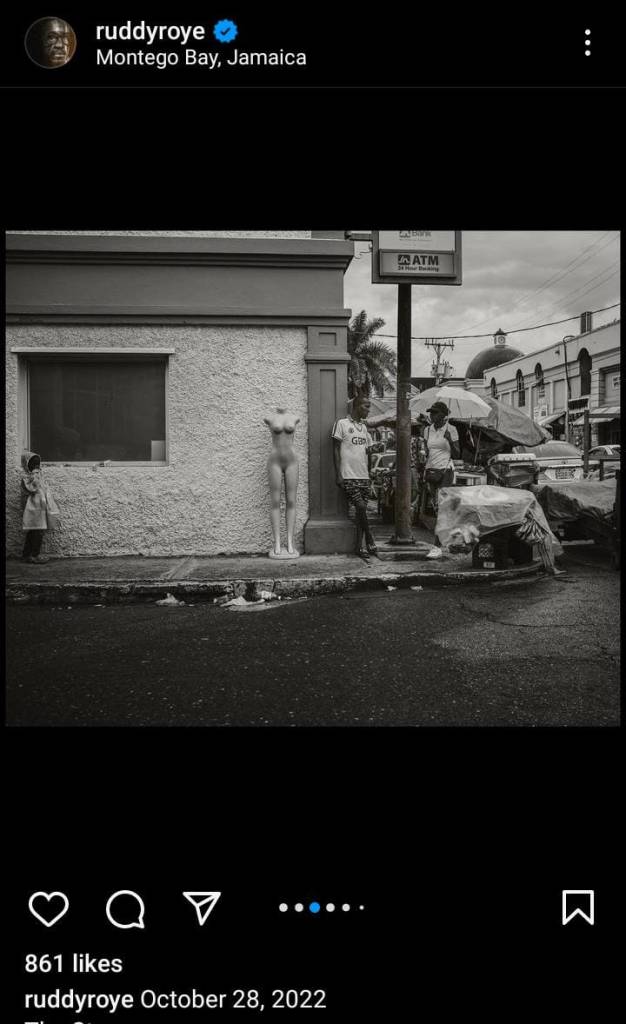
His “already-striking images” posted on Instagram are paired with lengthy captions that aim to add dimensions. A picture says a thousand words, and with art being left open to interpretation and the notion of meaning is not fixed, I appreciate his detailed explanations and his ability to say what he means. Another thing I found mind-blowing that really resonates with me is that he “insists that his photographs show his collaborators rather than his subjects.” I know in many art forms, especially photography and painting, and even activism campaigns, subjects are viewed simply as subjects. The portrayal of them as real people often goes unfulfilled. Thus, this then brings us back to question of what Digital Humanities Activism can do for others. We need not forget how projects done for minority communities not only benefit them, but also negatively impact them.
 Sylvia Wynter's Dream
Leave a comment